Vitaly Gorlachev
Deputy director, production
Coating repair
We open the live pipeline in short sections, strip the old coating, apply cold-applied tape and check every stage. More than 40 km of coating repaired.
We complete permits and briefings, carry out electrometric sounding and mark the repair locations. Work follows the technical regulations in force.
The pipe position is confirmed by trial pits, manual probing and instruments. The excavator bucket stays at least 0.5 m from the pipe; in practice the open section is no longer than 15 m.
Where groundwater is high we drive sheet piles and install dewatering: the slopes are secured and the risk of collapse is kept to a minimum.
With scrapers and brushes to grade 4 of VSN 008-88. Scrapers do not damage the pipe body. Laboratory specialists check the metal for defects.
Primer goes on in an even layer by roller and brush. Tape is applied with a hand-driven wrapping device that keeps overlap and tension constant around the pipe.
We check coating thickness, adhesion and continuity. Backfilling includes manual tamping of soil under the bottom of the pipe.
The loaded wrapping device weighs under 100 kg for a 1200 mm pipe. The load on the gas pipeline is minimal, so work is possible even where the pipe body has defects.
BPI tape needs no heating next to the works, which rules out ignition.
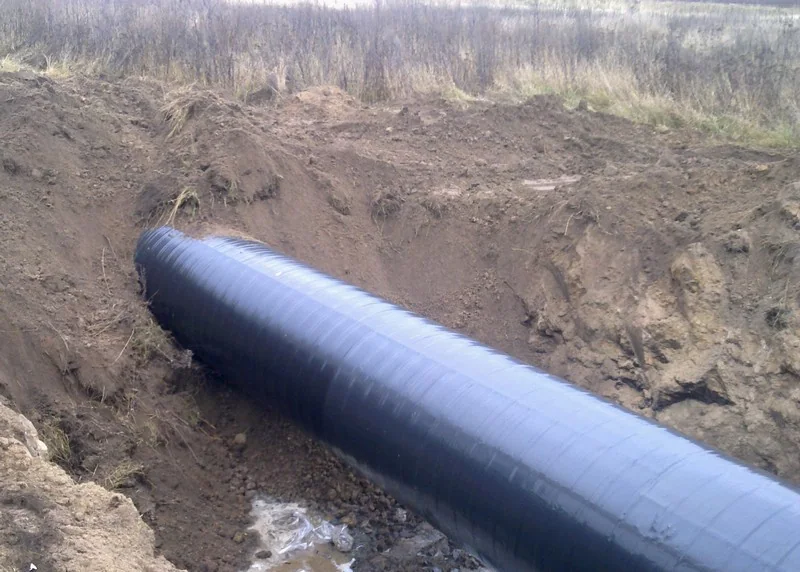
Company photographs
In good conditions, 40–45 m on a pipeline 1000–1200 mm in diameter.
Sheet piles and dewatering units are used. This secures the trench slopes.
The company's laboratory specialists check thickness, adhesion and continuity, with visual inspection throughout the work.
Deputy director, production
Diameter, length, product, commissioning year and earlier survey documents help us answer to the point.